
MOST people want to save money. It represents your hard work, but more accurately, your comparative value in the global marketplace of material transactions. That’s the cold truth, and oftentimes it creates some unfair situations. Unless it’s someone else’s money, or you’re a member of the establishment elite, where your value has long been detached from any notion of what you provide, there’s always a price threshold where you start to think, “Can I afford that?”
For travel, this pressure reaches its absolute peak. Prices can rise significantly when we’re moving around. You live a vacation lifestyle and this inflates your cost. And there is the additional pressure of low-income areas and service workers that pushes people to spend more money because they’re more fortunate.
In Portuguese, they have a negative expression for someone that doesn’t like to spend – our equivalent of cheapskate – “Mão de Vaca” – literally, “Hand of Cow”. I have no idea where it came from, but I found it funny enough to remember it.
Social phenomenon 1: People have a spectrum of what they consider frugal vs cheapskate. For example, if you make $100,000/yr, you might see someone that makes the same and lives on $50,000 as frugal. But if you meet someone that makes $100,000 but only spends $10,000, they must be a cheapskate!
Social phenomenon 2: If you make $100,000 and you see someone living on $50,000, but they spend it all, you probably won’t see this as frugal. You will either see this as unfortunate circumstances, bad money management, or both.
Social phenomenon 3: Thus, depending on income level, a moral value is assigned to someone based on their savings level. Too low is “wasteful”, but too high is “miserly”.
Now, whether something is “wasteful” would best be a topic for another day (you can probably guess which side I lean towards), but I want to address the “miserly” lifestyle.
The Bare Necessities
Modern culture has been so influenced so heavily by consumerism, the banking industry, and social media, that they have completely forgotten what a “necessity” is.
After high school, I lived in a poor area of Brazil on $300/m, including rent. You can live on that. Will it be the best lifestyle? No. Would I do it again? No. I couldn’t make it work now that my life is more established. Then, there’s the issue of healthcare as you get older. But the mere fact that I could live on that – with food, running water, and working electricity – it really wasn’t that bad once I got used to it – opened my mind to how wasteful modern society really is.
When I finally graduated college and started living on $2,000/m in the US (this was early 2020s), I felt like the RICHEST man in the world! I was living a “lower-income” lifestyle, but couldn’t imagine spending more money. I had my own nice place, car, good food, insurance, WiFi, etc. (forget buying a house though lol) I could have lived on much less and still been comfortable. If I could do that phase of my life again, I probably would have been even more frugal.
Most are just unwilling to compromise on lifestyle. They’re unwilling to pass up on the 23rd new iPhone, even though theirs is fine (and probably better with all the enshitification going on). They’re unwilling to get an older used car. They’re unwilling to cook at home. They’re unwilling to get roommates. They shop at the mall. They think raising a kid costs $2,000/m. You get the idea.
Spending as a Moral/Economic Necessity?
Many carefully disguise their lazy spending tendencies by dressing it up in moralism. Spending more than is needful, they say, will increase wealth in less fortunate places.
These places were fine before you got there, and they’ll be fine when you leave. In fact, bad spending can hurt an economy more than helping it. You’re allocating resources into areas of the economy that provide no real benefit to its citizens.
A good example is tipping culture. People that say things like “it may not be the culture here, but I like to reward good service”, but go on to tip literally everyone. This is not how other countries do things. When you provide a service, you get paid according to what was previously agreed upon. No more.
Imagine how ridiculous it would be if we applied this logic in reverse. “I’m paying you an agreed upon amount to do something… so you should reward me by providing extra service.” This is different from offering more up front for better service. Why is your labor subject to an additional “niceness fee”, but my labor (that I have converted into cash) isn’t?
I am well in favor of tipping, when something is exceptional. One time I paid a Grab driver double for bearing with me when I didn’t have any change. I had some other drivers that went above and beyond to get me into typically off-limit areas, and tipped them as well.
This becomes the expectation in tourist areas, makes the experience much less enjoyable, and puts pressure on locals that can no longer afford services in their own country. When I was in Ninh Binh, Vietnam, the boat guide asked us for a tip every five minutes. Way to break up the beauty of our surroundings.
The money you spend on tipping is not going to be reinvested into the local economy lol. It is going to be spent on beer and detract attention away from meaningful improvements. A country that makes a significant portion off of tourism is much less inclined to invest in other parts of its economy that allow them to be less dependent on richer nations. Macau gets 70% of its GDP from tourism. If something happens to China, Macau is fucked.
Your brain is playing tricks on you to fix your immediate surroundings the same way puppies manipulate you with their cuteness. It is a savior-complex doomed to help as much as the US has “helped” by devoting $8 trillion dollars to the Middle East.
Can We Have Nice Things?
If you’re on this blog, you’re probably similarly minded to me, and sometimes question if you’re going too far overboard with saving money at the risk of trip enjoyment. Can’t you travel affordably and still experience nice things?
The answer is YES! I am not advocating for a backpacker’s lifestyle. I couldn’t stand hostels for more than a couple weeks, so I normally found my own place. I paid for some pricey experiences while travelling and occasionally fine-dined. I did things absolute budget travellers would never do, like getting airline add-ons, deliveries, and staying in the occasional luxury hotel.
Positive vs Negative Amortization
The key is the amortization rate. Meaning, if the higher cost items are spread out over more time, at opportune moments, the cost is easy to mitigate with a cheaper base lifestyle. You don’t need luxury every day – you just like to occasionally experience it. I call this a positive amortization because it adds to your per diem.
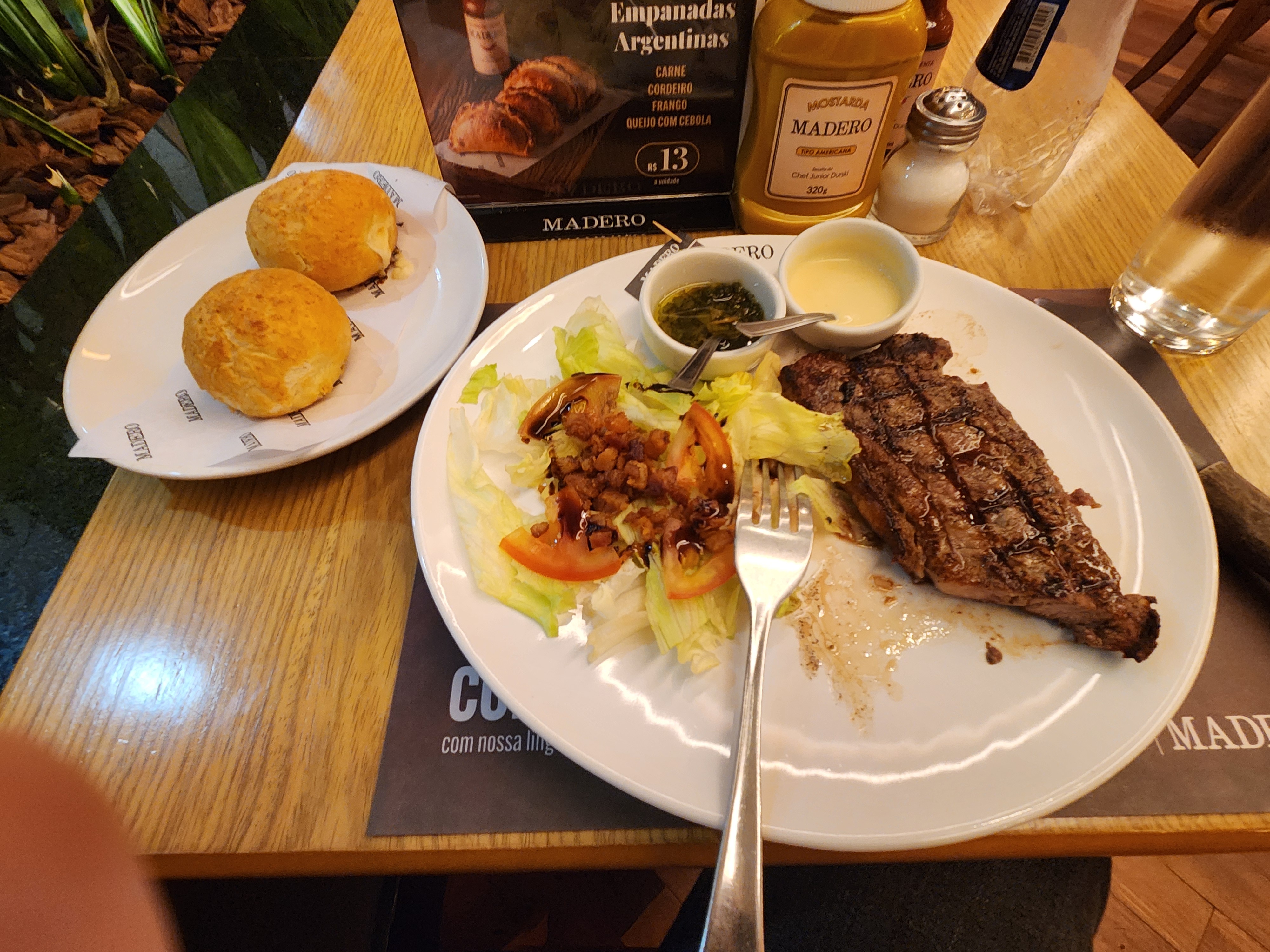
Couple examples: I spent a night in a luxury apartment in Kuala Lumpur, with a fantastic view of the Petronas Twin Towers, but the rest of the month I was staying in a pretty basic studio for $500 (yep, the whole month I spent $800 total). This made my per diem rate super low. When I was in Argentina, I knew I had to try their steak. Out of the two weeks I had, I mostly ate grocery and street food. That made dropping $100 on a multi-course fine dining experience not so bad.
On the other hand, we have negative amortization. This is when you spread out cheaper, less comfortable experiences to lower your per diem. Example: staying in an AirBNB, followed by a couple days in a hostel, then going back to an AirBNB. Staying in a hostel isn’t so bad, but it does affect sleep and hygiene – more chance of getting sick and you can’t keep your stuff out in the room. That’s why I only did them a few days at a time.
The other key is to know when to go for positive vs negative amortization events. For example, if you want a nice steak dinner in Dubai, get ready to shell out. On the other hand, I had some fantastic dinners for around $20 in LATAM. As a general rule of thumb, do positive amortization in cheap areas, and negative amortization in expensive areas. This also helps you avoid risk from cheap experiences in poorer countries (much less likely to get food poisoning from a street vendor in Vienna than one in Manila).
If you spread your positive and negative amortization events out wisely, you will reach a nice low per diem.
Remember, the VAST majority of people you see while travelling are locals to that area, or local travellers. This means that prices (with the exception of some luxury experiences that tailor to foreigners) are heavily tied to the local economy. This means if you travel like a local, you pay local prices. This can get you pretty far if you’re coming from a place with out of control cost of living.
Exceptions
Don’t let scrupulousness get in the way of peak experiences you’ve always dreamed of! If you’re travelling the world, this is your chance to do things you wouldn’t be able to do anywhere else. Paying a little more is worth it. Just make sure your desires are clearly defined so you are not constantly being pressured to spend. I flew in a helicopter over Iguazu Falls. NOT CHEAP. Like $120 for 10 minutes. But I only had one day to enjoy it, and I had always wanted to go to Iguazu, and especially ride a helicopter. It killed multiple birds for me. Worth it.
Don’t let it hold you back from being generous and doing good when the situation calls for it. Buy someone an ice cream once in while – don’t be a cow hands.
 Tightwad Travelling
Leave a comment